

MCP-B AI Browser Automation
Quick answer: Equal Efforts offers AI Agent Development and Data pipelines & ETL automation services that can be combined with the open‑source MCP-B AI browser automation protocol. This guide shows technical founders and AI engineers how to connect MCP‑B to an Equal Efforts AI agent, secure the workflow, and scale data extraction for RAG pipelines in fintech, healthcare, or SaaS environments.
What is MCP-B and how does it enable AI‑driven browser automation?
MCP‑B is a lightweight protocol designed for programmatic control of web browsers. It defines a small set of JSON‑based commands (navigate, click, extract, etc.) that can be issued from any language runtime. Because the protocol is transport‑agnostic, AI agents can invoke browser actions as part of a larger data‑retrieval workflow without embedding a full Selenium stack.
Key points
- Minimal overhead – only essential commands, reducing latency.
- Stateless design – each request contains all context, simplifying scaling.
- Open‑source – the specification is publicly available, encouraging community extensions.
When an AI‑driven system needs fresh web data—e.g., market prices or clinical‑trial results—MCP-B AI browser automation can fetch the page, run OCR or DOM parsing, and return structured JSON directly to the RAG (Retrieval‑Augmented Generation) pipeline.
How can technical founders integrate MCP-B with Equal Efforts AI & Automation services?
Equal Efforts lists AI Agent Development under its AI & Innovation portfolio and Data pipelines & ETL automation under AI & Automation. The integration follows three logical layers:
Step‑by‑step outline
- Create an AI agent using Equal Efforts’ AI Agent Development service. Define a “fetch‑web‑data” intent that accepts a URL and optional selectors.
- Deploy a lightweight MCP‑B runner (e.g., a Docker container with headless Chrome). Expose an HTTPS endpoint that respects the MCP‑B JSON schema.
- Configure the agent to POST an MCP-B AI browser automation command, for example:
{ "action": "navigate", "url": "{{input_url}}" }- Receive the response (HTML, OCR text, or extracted fields) and pass it to the Data pipelines & ETL automation workflow for cleansing and storage.
- Trigger the RAG pipeline – the cleaned data becomes a knowledge source for downstream LLM generation.
The external link to the W3C Web Standards can be referenced in the agent’s documentation to align selector syntax with industry norms.
Why use MCP-B AI browser automation for faster data extraction in RAG pipelines?
RAG pipelines rely on timely, high‑quality retrieval to augment generative models. Traditional scraping stacks (Selenium + custom parsers) introduce latency because of heavyweight drivers and complex session handling. MCP-B AI browser automation reduces that overhead by:
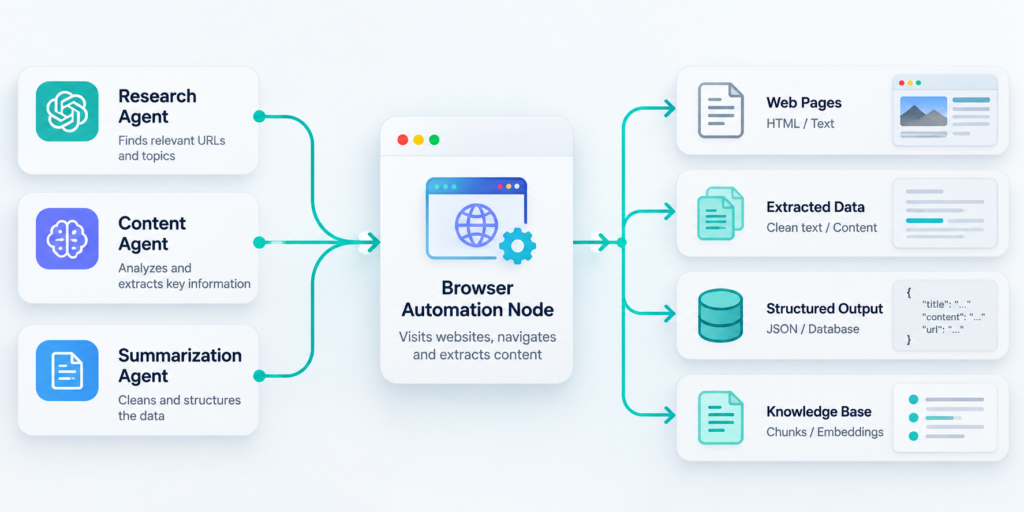
- Sending concise JSON commands instead of full WebDriver scripts.
- Running stateless sessions, allowing horizontal scaling behind a load balancer.
- Enabling direct hand‑off to Equal Efforts’ ETL automation, which can batch‑process results and feed them into vector stores without intermediate file writes.
The net effect is a shorter end‑to‑end latency, which improves the relevance of generated answers in time‑sensitive domains like finance or patient monitoring.
Which Equal Efforts solutions support AI agent development for automation?
Equal Efforts’ AI Agent Development service (listed on the AI & Innovation page) focuses on building intelligent, task‑specific agents. These agents can:
- Invoke external APIs (including MCP-B AI browser automation endpoints).
- Perform conditional logic based on extraction results.
- Emit events that trigger the Data pipelines & ETL automation stack (see the AI & Automation page).
Together, the two services provide a complete “agent‑to‑browser‑to‑pipeline” chain without requiring custom glue code.
Can MCP-B AI browser automation improve security in AI‑powered data pipelines?
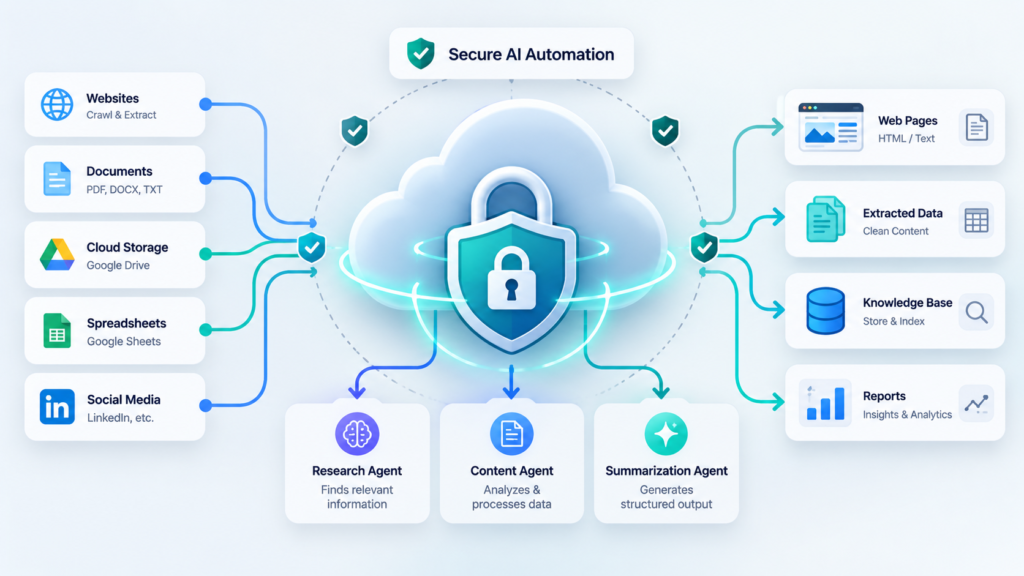
Yes. When combined with Equal Efforts’ cloud and DevOps expertise, MCP-B AI browser automation can be hardened:
- TLS encryption for all MCP‑B HTTP traffic.
- Authentication tokens issued by the AI agent and validated by the browser runner.
- Audit logging integrated with Equal Efforts’ monitoring tools, capturing each command and response for compliance review.
These measures align with typical enterprise security expectations for data extraction, even though specific certifications (e.g., SOC 2) are not claimed in the source material.
Should AI engineers choose MCP-B for scalable browser automation?
MCP-B AI browser automation offers a pragmatic balance of simplicity and extensibility. For teams that already use Equal Efforts’ AI Agent Development and ETL automation, adopting MCP‑B avoids the operational burden of maintaining full Selenium grids. It also fits naturally into container‑orchestrated environments, enabling horizontal scaling as data volume grows.
Learn more about AI Innovation Services.
Key Takeaways
- MCP-B AI browser automation provides a lightweight, JSON‑based protocol for browser control, ideal for AI‑driven data extraction.
- Equal Efforts’ AI Agent Development and Data pipelines & ETL automation services form the core integration points.
- Secure, stateless sessions enable fast, scalable RAG pipeline enrichment.
- The approach works across fintech, healthcare, and SaaS use cases without reinventing the automation stack.
Frequently Asked Questions
What prerequisites are needed to start using MCP-B with Equal Efforts services?
You need a Docker‑compatible host for the MCP‑B runner, an HTTPS endpoint with a valid certificate, and access to Equal Efforts’ AI Agent Development and Data pipelines & ETL automation offerings. Basic knowledge of JSON and REST APIs is sufficient.
How does OCR fit into the MCP‑B workflow?
If the target page contains images with text, the MCP‑B runner can invoke an OCR library (e.g., Tesseract) after page capture. The extracted text is returned in the JSON response and then processed by the ETL automation step.
Can I monitor MCP‑B command performance?
Yes. Equal Efforts’ cloud‑monitoring tools can ingest the audit logs from the MCP‑B runner, allowing you to track latency, error rates, and throughput per agent.
Is the MCP‑B protocol compatible with headless browsers other than Chrome?
The protocol itself is browser‑agnostic; any headless engine that can interpret the defined JSON commands can be used, provided it adheres to the same response format.
Where can I find more resources on building AI agents at Equal Efforts?
Visit the AI & Innovation page for details on AI Agent Development, and the AI Automation Solutions page for pipeline and OCR automation capabilities.
