
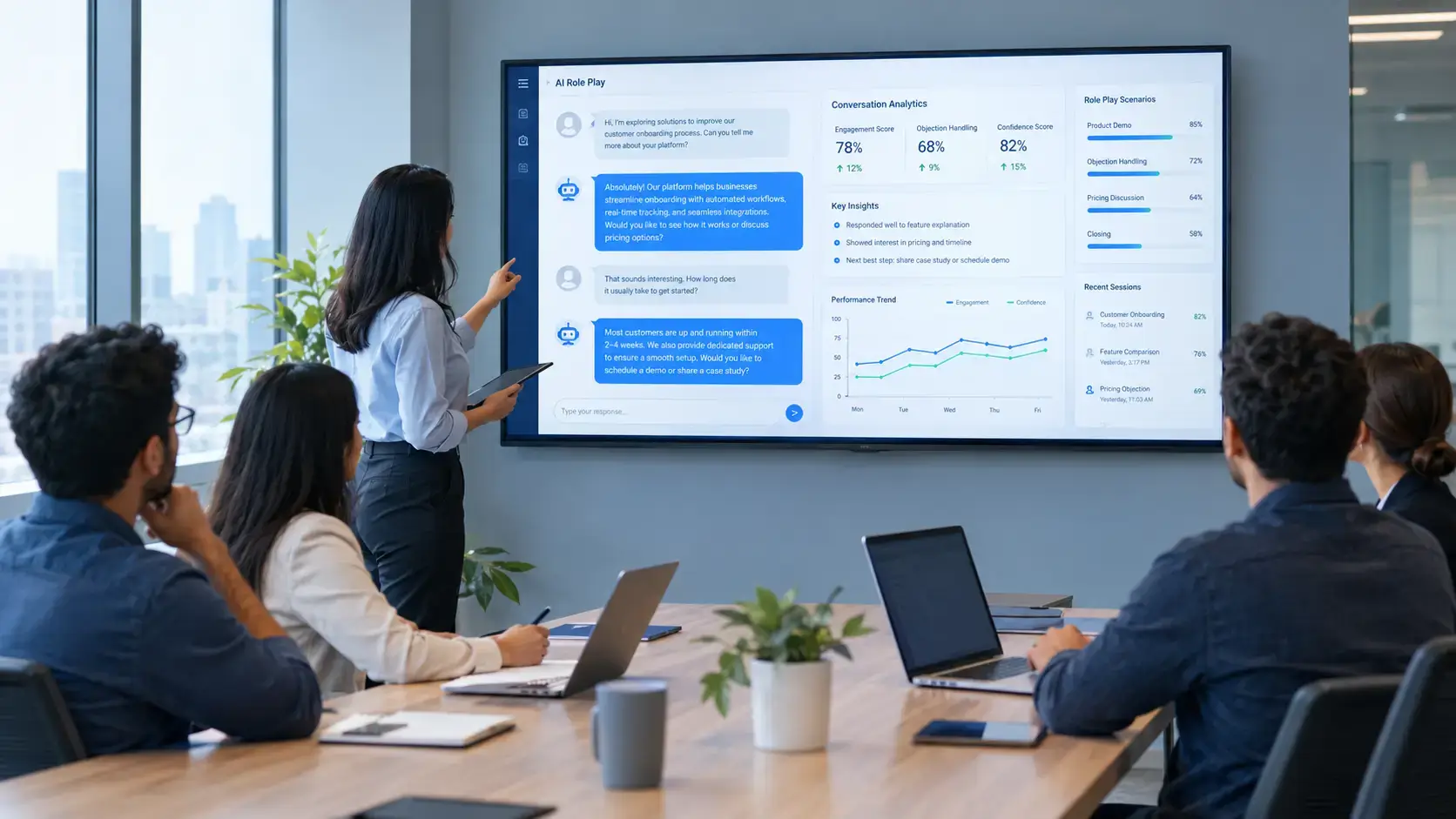
AI roleplay sales training: Boost Lead Qualification and Close Rates
AI‑driven role‑play uses large language models to generate realistic sales conversations, letting reps rehearse objection handling at scale. By linking scenario outcomes to CRM data, teams can track skill growth, increase qualified opportunities, and improve close rates across multiple B2B markets.
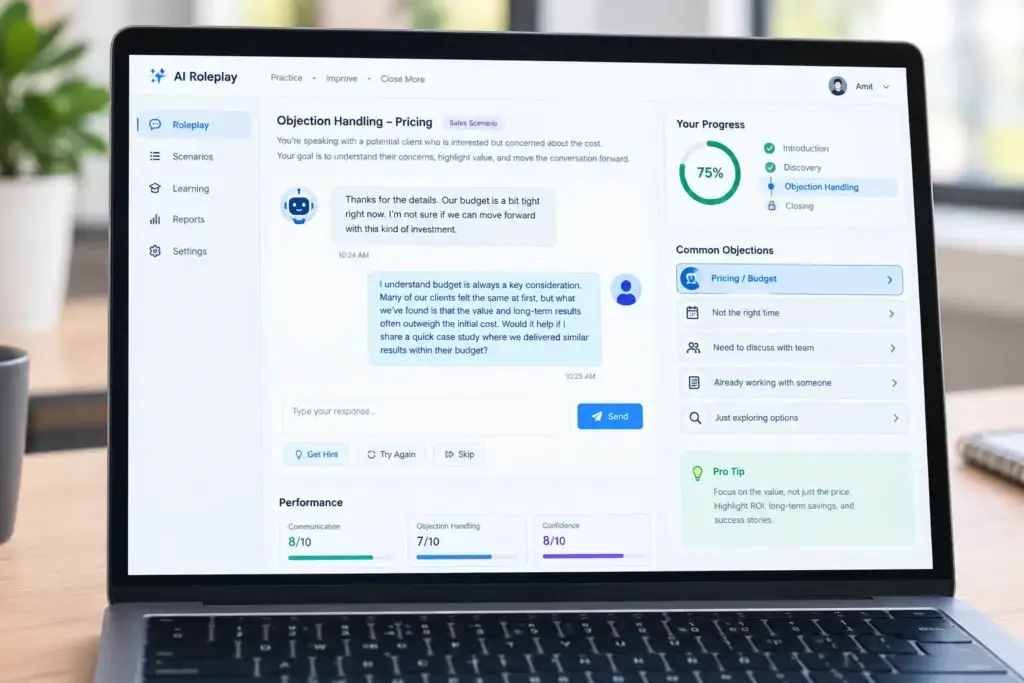
What is AI roleplay sales training?
AI roleplay sales training leverages conversational AI, typically large language models, to simulate buyer interactions. The system presents a virtual prospect, poses common objections, and evaluates the rep’s responses in real time. Because the dialogue is generated on the fly, each practice session can vary, mimicking the unpredictability of real‑world calls. This approach turns abstract coaching into concrete, repeatable exercises that can be measured and refined.
How can AI roleplay sales training boost lead qualification?
AI simulated conversations improve lead qualification in three ways:
- Skill acceleration – Reps practice handling price, timing, and compliance objections repeatedly, building confidence faster than traditional role‑play workshops.
- Data‑driven feedback – The platform records response time, sentiment, and adherence to playbooks, feeding scores back into the CRM for visibility.
- Scalable coverage – Unlimited virtual prospects mean every rep can train daily, ensuring the entire pipeline is staffed with qualified sellers.
When teams adopt AI roleplay sales training, they often notice smoother handoffs and a higher proportion of inbound inquiries that move from “cold” to “qualified” because reps are better prepared to address concerns the moment they arise.
Why should B2B sales teams use AI for objection handling?
Objection handling is a proven predictor of close rates. AI‑driven objection practice offers:
- Consistency – Every rep encounters the same core objections, ensuring uniform mastery of key messaging.
- Personalization – The AI can tailor scenarios to industry‑specific challenges (e.g., HIPAA compliance for healthcare or PCI‑DSS for finance) without manual script updates.
- Continuous improvement – Machine learning automation analyzes aggregate performance, highlighting emerging objection trends that can be fed back into sales enablement platforms.
Embedding AI objection handling practice into onboarding and ongoing coaching helps new hires become productive faster and keeps veteran reps sharp.
Learn more about AI innovation services.
Which CRM integrations work best with AI roleplay tools?
| Integration Type | Typical Data Flow | Benefit |
|---|---|---|
| Bidirectional sync | Scenario scores ↔ Lead records | Managers see qualification scores directly on opportunity dashboards. |
| Event triggers | Completion of a role‑play session → Task creation | Automates follow‑up coaching or assigns a mentor based on performance gaps. |
| Analytics export | Detailed conversation logs → BI tools | Supports deeper analysis of objection trends across territories. |
For guidance on connecting applications and services effectively, explore Microsoft’s integration architecture design guide.
Effective AI roleplay systems expose integration points that align with common CRM standards:
Most platforms provide connectors for leading CRMs via APIs or native plugins. Prioritize solutions that support real‑time data exchange and meet your organization’s security policies.
Can AI roleplay improve close rates for SaaS deals?
While results vary by organization, the mechanics suggest a positive impact:
- Higher qualification – Reps who consistently overcome price and ROI objections are more likely to move prospects to the evaluation stage.
- Shortened sales cycles – With practiced responses, meetings stay on track, reducing the number of follow‑up calls needed.
- Improved forecasting – CRM‑linked performance metrics give leadership clearer visibility into rep readiness, leading to more accurate pipeline predictions.
Implementing AI roleplay sales training can therefore contribute to incremental gains in SaaS close rates.
Step‑by‑step AI roleplay implementation guide
- Define objectives – Identify the key objections and qualification criteria you want to improve (e.g., budget, decision‑maker authority).
- Design scenario library – Work with subject‑matter experts to script baseline buyer personas and objection trees.
- Select a conversation AI engine – Choose a platform that supports LLM‑based chatbots and offers customization for your industry language.
- Build analytics dashboards – Configure metrics such as response accuracy, sentiment score, and time‑to‑reply.
- Integrate with CRM – Set up bidirectional sync so scenario outcomes update lead status and trigger coaching tasks.
- Pilot with a small team – Run a 4‑week trial, collect feedback, and fine‑tune scenario difficulty.
- Roll out organization‑wide – Deploy to all reps, embed training into onboarding, and schedule regular refresh cycles.
- Monitor and iterate – Review KPI trends monthly, adjust objection scripts, and expand scenario coverage as market conditions evolve.
Implementing AI role-play sales training can also align coaching metrics with revenue goals, creating a clear link between practice and performance.
Measuring success: Metrics and reporting
To prove value, track a blend of leading and lagging indicators:
- Qualification score – Composite rating from scenario performance linked to lead status.
- Objection resolution rate – Percentage of calls where the rep successfully addresses the targeted objection.
- Average deal velocity – Time from qualified lead to closed‑won, compared before and after implementation.
- Rep confidence index – Survey‑based self‑assessment collected quarterly, correlated with performance data.
Present these metrics in a dashboard that pulls data from both the AI roleplay platform and the CRM, enabling sales leadership to make data‑driven decisions about coaching investments.
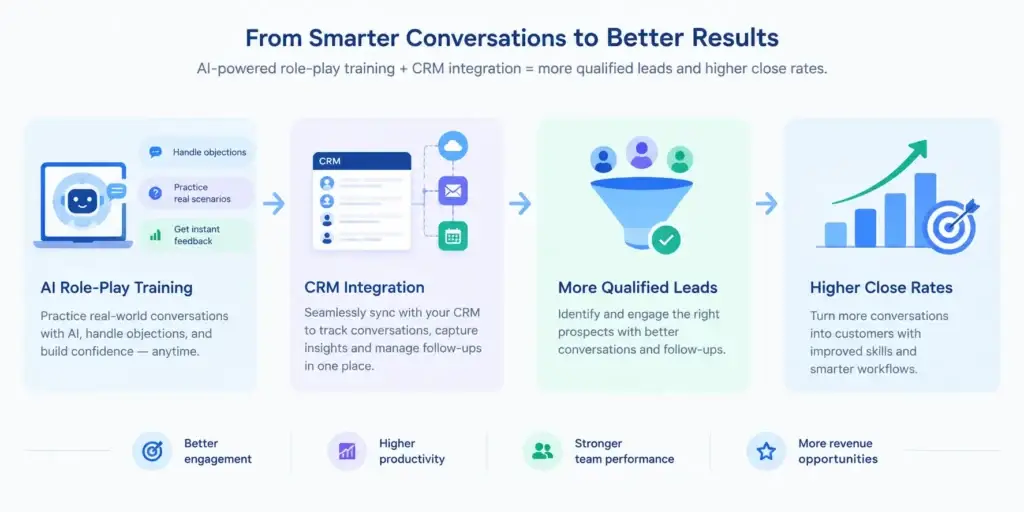
Key Takeaways
- AI roleplay sales training creates realistic, repeatable objection handling practice using large language models.
- Linking scenario outcomes to CRM records turns training into a measurable component of lead qualification.
- Scalable, data‑driven practice shortens sales cycles and can lift close rates for SaaS and other B2B sectors.
- A structured implementation — objectives, scenario design, integration, pilot, rollout—ensures smooth adoption.
- Ongoing metrics such as qualification scores and objection resolution rates provide clear visibility into ROI.
- Overall, AI roleplay sales training serves as a bridge between theory and practice.
Frequently Asked Questions
What technology powers AI roleplay scenarios?
Generative AI models, often built on large language models, generate dynamic dialogue. Machine learning automation evaluates responses, while conversation AI interfaces present the interaction to the rep.
How long does it take to see improvement in lead qualification?
Improvements typically emerge after a few weeks of regular practice, as reps internalize objection handling patterns and the system begins feeding performance data back into the CRM.
Is AI roleplay suitable for regulated industries like finance or healthcare?
Yes, because the platform can be configured with industry‑specific language and compliance considerations, ensuring that simulated objections reflect real regulatory constraints.
Can the system be used for onboarding new sales hires?
Absolutely. New reps can complete a series of role‑play modules that mirror the onboarding curriculum, receiving instant feedback and automatically updating their progress in the CRM.
What level of technical expertise is required for integration?
Most solutions offer pre‑built connectors for major CRMs, reducing the need for deep development work. A small team of sales ops and IT staff can typically handle configuration and monitoring.
