

Future‑Proof Software Engineering Skills
AI agents, chatbots, machine‑learning models and automation tools are now common ways to embed large language models into code, documentation and workflow automation, helping engineering teams stay productive and competitive.
What core competencies do future‑proof software engineering skills require?
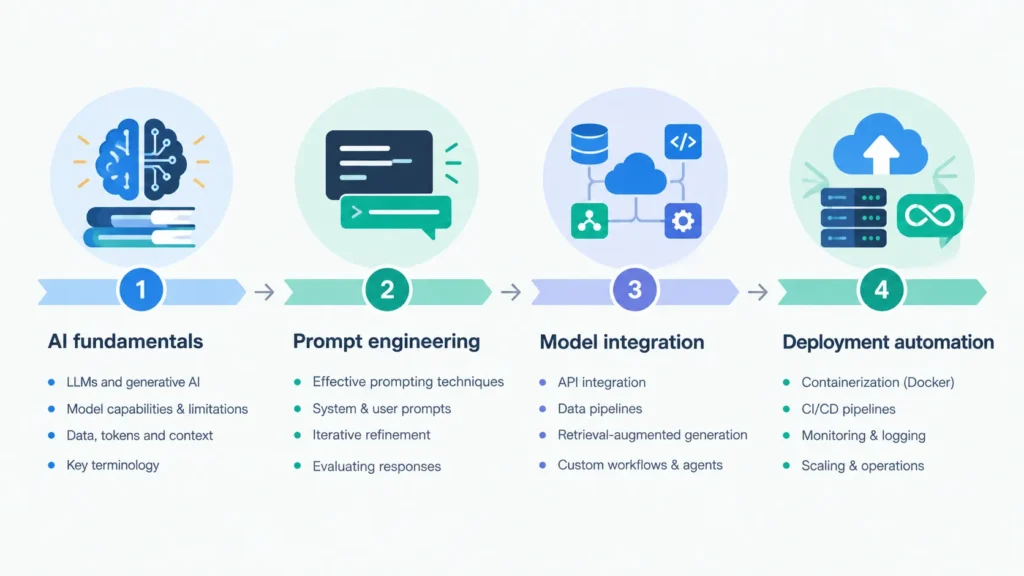
Engineers must blend classic development expertise with AI‑specific abilities. Typical focus areas include:
- Prompt engineering – crafting inputs that guide large language models to produce reliable code snippets or documentation.
- Model integration – wiring LLM APIs or custom models into applications while handling authentication, rate limits and response parsing.
- Data hygiene for ML pipelines – collecting, cleaning and labeling data that fuels model training or fine‑tuning.
- Automation scripting – using Python, Bash or PowerShell to orchestrate CI/CD pipelines that trigger AI‑driven tests or code reviews.
- AI‑augmented debugging – leveraging tools that suggest fixes, spot performance bottlenecks or generate test cases.
- Ethical and security awareness – spotting bias, privacy concerns and compliance implications when deploying generative AI.
Understanding how large language models work—and where they fall short—forms the foundation of any future‑proof software engineering skills portfolio.
How can engineering managers design a learning path that builds future‑proof software engineering skills?
A structured roadmap keeps upskilling purposeful and measurable. Consider these milestones:
| Milestone | Focus | Typical Resources |
|---|---|---|
| Foundations | AI basics, LLM concepts | Intro courses on major MOOC platforms, free university lectures |
| Prompt Engineering | Designing effective prompts, few‑shot techniques | Interactive labs from AI platform providers, community tutorials |
| Model Integration | API usage, error handling, versioning | Official SDK docs, sample GitHub repos |
| Automation & CI/CD | Adding AI steps to pipelines, DevOps automation | Jenkins/GitHub Actions guides, community webinars |
| Fine‑Tuning & Customization | Adapting models to domain data | Workshops on model fine‑tuning, public notebooks |
| Governance | Bias mitigation, security, compliance | Whitepapers from standards bodies, internal policy templates |
Assign a champion for each milestone, schedule short “learning sprints,” and capture outcomes in a shared knowledge base. Regular demos reinforce retention and surface real‑world use cases, ensuring the team’s future‑proof software engineering skills stay current.
Why is upskilling in AI tools essential for maintaining future‑proof software engineering skills?
AI tools are reshaping the AI‑driven development workflow by automating repetitive tasks such as code generation, test creation and documentation. Teams that adopt these tools can:
- Shorten cycle time for feature delivery.
- Improve code quality through AI‑suggested refactorings.
- Free senior engineers to focus on architecture and innovation.
- Meet market expectations where clients look for AI‑enhanced products.
Without the relevant capabilities, engineers risk becoming bottlenecks, and organizations may fall behind competitors that embed AI agents and generative platforms into their pipelines.
Which resources help engineers quickly adopt generative AI into their workflow?
A blend of free and paid material accelerates learning:
Learn more about AI automation solutions.
- Official LLM documentation (e.g., OpenAI, Anthropic) – API reference and best‑practice guides.
- Interactive notebooks on platforms like Google Colab – experiment with prompt engineering and model fine‑tuning without local setup.
- Community forums (Stack Overflow, Reddit’s r/MachineLearning) – useful for troubleshooting integration quirks.
- Vendor‑agnostic courses – “AI for Developers” tracks on major learning sites focus on practical implementation.
- Internal hackathons – short, goal‑oriented events where teams build a prototype AI‑augmented feature and share lessons learned.
Pairing these resources with mentorship from early adopters speeds up engineering team AI readiness.
How can individuals assess their current readiness for future‑proof software engineering skills?
Start with a self‑audit: rate comfort with prompts, API usage and automation scripting on a simple scale. Identify the biggest gaps, then prioritize the highest‑impact skill—often prompt engineering—before moving to model integration or fine‑tuning. Document progress in a personal learning log and revisit it quarterly.
Learn more about AI innovation services.
Key Takeaways
- Future‑proof software engineering skills combine prompt engineering, model integration, automation scripting and ethical awareness.
- Managers can map a learning path with clear milestones, using a mix of courses, hands‑on labs and internal demos.
- Upskilling in AI tools directly influences delivery speed, code quality and market relevance.
- Leverage official docs, interactive notebooks and community knowledge to adopt generative AI quickly.
Frequently Asked Questions
How can I evaluate my AI readiness as a software engineer?
Conduct a quick self‑audit of comfort levels with prompts, API calls and automation. Highlight the top three gaps and create a short‑term plan to address them, starting with the skill that will deliver the most immediate benefit.
What’s the difference between prompt engineering and model fine‑tuning?
Prompt engineering shapes the input to an existing LLM to coax the desired output, while fine‑tuning adjusts the model’s weights with domain‑specific data, producing a customized version that may need fewer prompts for accurate results.
Are there certifications that validate AI‑augmented development abilities?
Industry‑wide certifications are still emerging, but many cloud providers and AI platform vendors offer role‑based badges for LLM API usage and responsible AI practices. These badges can be added to a professional profile to signal competence.
How much time should a team allocate each week for AI upskilling?
A common practice is a “learning sprint” of 2–3 hours per engineer per week, complemented by a monthly showcase where a small AI‑enhanced feature is demonstrated. This balances productivity with continuous improvement.
Can AI tools replace traditional code reviews?
AI tools can augment reviews by flagging potential bugs or suggesting improvements, but they do not replace the contextual judgment of human reviewers. Effective teams use AI as a first‑line filter, followed by peer review.
